
How Do You Raise Warehouse Tables That Are Too Low for Standing Work?
Back injuries are the leading cause of lost workdays in warehousing, and OSHA's General Duty Clause requires employers to address recognized ergonomic hazards — including work surface height. According to the CDC, back pain costs U.S. companies $225.8 billion per year, or approximately $1,685 per employee in lost productivity alone. Folding tables are at sitting height, approximately 28 inches, which is designed for a chair. For a worker on their feet, that surface forces the body into a forward bend at the waist and a dropped head — a posture that compounds with every repetition across a full shift. Folding table risers correct that in seconds by extending the legs of the tables a facility already owns.

Why Do Folding Tables Cause Back Pain in Warehouse Work?
A folding table at sitting height — approximately 28 inches — forces a standing worker to bend at the waist and drop their head to reach the surface. That posture feels manageable for a few minutes. Repeated hundreds of times a day across a full shift, it becomes the kind of cumulative strain that shows up on an OSHA 300 log as a musculoskeletal disorder.
Warehouse work compounds the problem. Packing, picking, sorting, labeling, and small parts assembly are repetitive by design. Overexertion and bodily reaction are the leading causes of serious injury in the transportation and warehousing sector, which carries the highest serious injury and illness rate of all 19 industry sectors tracked by BLS — an estimated 3.8 cases per 100 workers. Work surface height is one of the most direct contributors a safety team can correct without changing how the job is done.
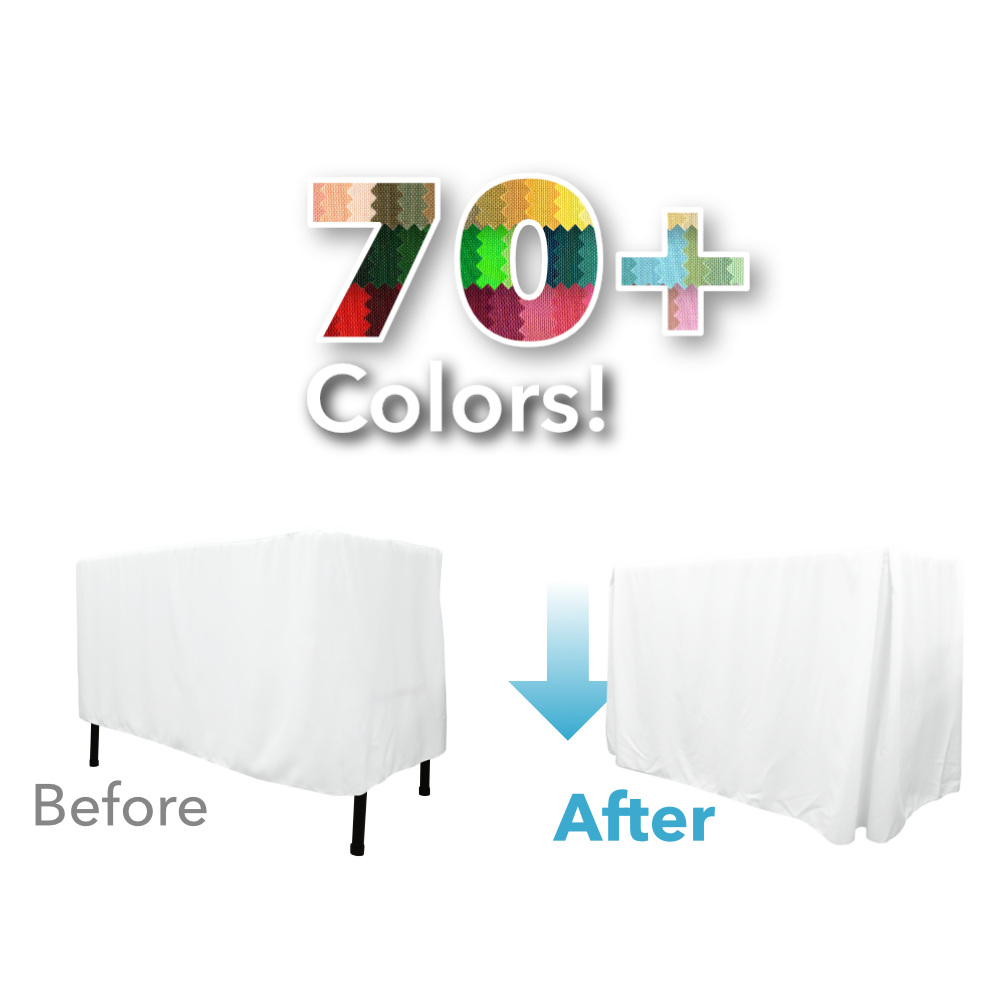
Raising the table is the direct fix. Lift Your Table® folding table risers slide onto the legs of a Bent Leg folding table and lift the whole surface in seconds, with no tools, no hardware, and no new furniture. The station stays exactly where it is. Only the height changes.
Are Makeshift Table Risers a Safety Hazard in Warehouse Environments?
Makeshift risers — stacked wood blocks, pallets under table legs — are a recognized safety hazard, not just a maintenance inconvenience. An improvised riser that sits uneven across four legs creates an unstable surface under load. If it shifts or collapses, the table, its contents, and anyone working at it are all at risk. That is an OSHA-recordable incident waiting to happen.
There is also a documentation problem. Improvised solutions cannot be entered into a safety equipment inventory, cannot be cited in an ergonomics program as a compliant fix, and offer no liability protection if a worker is injured. Under OSHA's General Duty Clause, a work surface that forces employees into repetitive bending and forward-leaning postures is a violation that requires immediate corrective action. When an inspector flags it, the clock starts. Lift Your Table® folding table risers are manufactured to a consistent height, weight-tested to withstand 500 pounds, documentable as actual safety equipment, and can be on the floor the same day they arrive. The station stays level, the fix stays fixed, and the safety record reflects a real corrective action.

What Is the Right Table Height for a Packing or Sorting Station?
Ergonomic guidelines recommend different working heights based on task type — and each tier maps directly to a riser height:
- Heavy work (force, lifting, downward pressure) — 28 to 36 inches
- Light work (sorting, packing, food prep, event setup) — 34 to 43 inches
- Precision work (labeling, inspection, detailed assembly) — 42 to 48 inches
Lift Your Table® folding table risers are available in three heights, each raising a standard folding table by a defined amount. Counter Height adds approximately 8 inches — suitable for heavy work stations or mixed sit-stand setups. Bar Height adds approximately 12 inches — the right range for light work and the most common warehouse application. XL Height adds approximately 20 inches — designed for precision stations and taller workers.
For facilities equipping multiple stations at once, Lift Your Table® Commercial Packs are available for bulk orders, making it straightforward to roll out a compliant ergonomic solution across an entire floor or facility in one purchase.
For a standard packing or sorting line, Bar Height is the practical starting point. It brings a 28-inch folding table to approximately 40 inches, which sits squarely in the light-work ergonomic range and suits the majority of standing adults without customization.
How Does Work Surface Height Fit Into an OSHA Ergonomics Program?
OSHA does not publish a specific numeric standard for work surface height, but the General Duty Clause requires employers to keep the workplace free of recognized hazards — and ergonomic hazards qualify when injuries are documented and the employer was aware of the risk. A team working daily at tables that are demonstrably too low for standing tasks, with a pattern of MSD claims on the OSHA 300 log, is a recognized hazard. Addressing it is not optional.
How Do Folding Table Risers Fit a Facilities or Safety Budget?
Folding table risers are a supplies-line purchase, not a capital expenditure — they work with the folding tables a facility already owns. There is no fleet to replace, no fixed workbenches to install, and no floor plan to redesign around permanent furniture. The tables keep doing what they were bought to do, at a height the crew can actually work at.
That structure suits procurement. A set of folding table risers is a small line item that can be approved at the facility level, piloted on one station, and rolled out across a site or a region once it proves out. Because the risers are lightweight and easily portable, they also travel with the work — seasonal packing lines, temporary staging areas, and returns processing stations all run on the same sets.
What Else Should Warehouse and Operations Managers Know About Lift Your Table®?
The risers fit Bent Leg folding tables with legs up to 1.25 inches in diameter. Compatibility images are on the product page, and a quick check against your current table stock before ordering makes rollout smooth.
Two foot types are available. The Movable Foot lets a crew reposition a table without removing the risers, which suits floors where layouts shift with the season. The Non-Slip Foot keeps a station planted firmly in place for fixed lines and high-volume workstations.
For teams with supplier diversity goals, there is an added benefit. Lift Your Table® is a WBENC Certified Women's Business Enterprise, is NMSDC MBE certified, and is made in the USA. Orders can count toward diverse spend targets while solving a floor-level safety problem at the same time.
Correcting work surface height in a warehouse does not require a redesign, a capital request, or a single new table. It requires four risers per station and about thirty seconds to install. For safety managers looking for documentable, low-friction ergonomic improvements that hold up under scrutiny, that is a strong place to start. Lift Your Table® has been helping operations and safety teams do exactly that since 2011.